A long long time ago, when most of the world was young and folk did what they liked because all things were good, there lived a boy called Jack.
His father was bed-ridden, and his mother, a good soul, was busy early morns and late eyes planning and placing how to support her sick husband and her young son by selling the milk and butter which Milky-White, the beautiful cow, gave them without stint. For it was summer-time.
But winter came on; the herbs of the fields took refuge from the frosts in the warm earth, and though his mother sent Jack to gather what fodder he could get in the hedgerows, he came back as often as not with a very empty sack; for Jack's eyes were so often full of wonder at all the things he saw that sometimes he forgot to work!
So it came to pass that one morning Milky-White gave no milk at all—not one drain! Then the good hard-working mother threw her apron over her head and sobbed:
"What shall we do? What shall we do?"
Now Jack loved his mother; besides, he felt just a bit sneaky at being such a big boy and doing so little to help, so he said, "Cheer up! Cheer up! I'll go and get work somewhere." And he felt as he spoke as if he would work his fingers to the bone; but the good woman shook her head mournfully.
"You've tried that before, Jack," she said, "and nobody would keep you. You are quite a good lad but your wits go a-wool-gathering. No, we must sell Milky-White and live on the money. It is no use crying over milk that is not here to spill!"
You see, she was a wise as well as a hard-working woman, and Jack's spirits rose.
"Just so," he cried. "We will sell Milky-White and be richer than ever. It's an ill wind that blows no one good. So, as it is market-day, I'll just take her there and we shall see what we shall see.""But—" began his mother.
"But doesn't butter parsnips," laughed Jack. "Trust me to make a good bargain."
So, as it was washing-day, and her sick husband was more ailing than usual, his mother let Jack set off to sell the cow.
"Not less than ten pounds," she bawled after him as he turned the corner.
Ten pounds, indeed! Jack had made up his mind to twenty!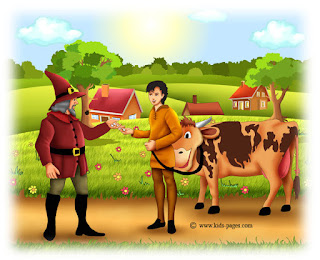
He was just settling what he should buy his mother as a fairing out of the money, when he saw a queer little old man on the road who called out, "Good-morning, Jack!"
"Good-morning," replied Jack, with a polite bow, wondering how the queer little old man happened to know his name; though, to be sure, Jacks were as plentiful as blackberries.
"And where may you be going?" asked the queer little old man. Jack wondered again—he was always wondering, you know—what the queer little old man had to do with it; but, being always polite, he replied:
"I am going to market to sell Milky-White—and I mean to make a good bargain."
"So you will! So you will!" chuckled the queer little old' man. "You look the sort of chap for it. I bet you know how many beans make five?"
"Two in each hand and one in my mouth," answered Jack readily. He really was sharp as a needle.
"Just so, just so!" chuckled the queer little old man; and as he spoke he drew out of his pocket five beans. "Well, here they are, so give us Milky-White."
Jack was so flabbergasted that he stood with his mouth open as if he expected the fifth bean to fly into it.
"What!" he said at last. "My Milky-White for five common beans! Not if I know it!"
"But they aren't common beans," put in the queer little old man, and there was a queer little smile on his queer little face. "If you plant these beans over-night, by morning they will have grown up right into the very sky."
Jack was too flabbergasted this time even to open his mouth; his eyes opened instead.
"Did you say right into the very sky?" he asked at last; for, see you, Jack had wondered more about the sky than about anything else.
"RIGHT UP INTO THE VERY SKY" repeated the queer old man, with a nod between each word. "It's a good bargain, Jack; and, as fair play's a jewel, if they don't—why! meet me here to-morrow morning and you shall have Milky-White back again. Will that please you?"
"Right as a trivet," cried Jack, without stopping to think, and the next moment he found himself standing on an empty road.
"Two in each hand and one in my mouth," repeated Jack. "That is what I said, and what I'll do. Everything in order, and if what the queer little old man said isn't true, "Yes," replied Jack, beginning to doubt his own wisdom; "but they're magic beans.
 Up to the very sky? Jack meant to see at any rate.
So he climbed, and he climbed, and he climbed. It was easy work, for the big beanstalk with the leaves growing out of each side was like a ladder; for all that he soon was out of breath. Then he got his second wind, and was just beginning to wonder if he had a third when he saw in front of him a wide, shining white road stretching away, and away, and away.
So he took to walking, and he walked, and walked, and walked, till he came to a tall, shining white house with a wide white doorstep.
And on the doorstep stood a great big woman with a black porridge-pot in her hand. Now Jack, having had no supper, was hungry as a hunter, and when he saw the porridge-pot he said quite politely:
"Good-morning, ' I wonder if you could give me some breakfast?"
"Breakfast!" echoed the woman, who, in truth, was an ogre's wife. "If it is breakfast you're wanting, it's breakfast you'll likely be; for I expect my man home every instant, and there is nothing he likes better for breakfast than a boy—a fat boy grilled on toast."
Now Jack was not a bit of a coward, and when he wanted a thing he generally got it, so he said cheerful-like:
"I'd be fatter if I'd had my breakfast!" Whereat the ogre's wife laughed and bade Jack come in; for she was not, really, half as bad as she looked. But he had hardly finished the great bowl of porridge and milk she gave him when the whole house began to tremble and quake. It was the ogre coming home!
Thump! THUMP!! THUMP!!!
"Into the oven with you, sharp!" cried the ogre's wife; and the iron oven door was just closed when the ogre strode in. Jack could see him through the little peep-hole slide at the top where the steam came out.
He was a big one for sure. He had three sheep strung to his belt, and these he threw down on the table. "Here, wife," he cried, "roast me these snippets for breakfast; they are all I've been able to get this morning, worse luck! I hope the oven's hot?" And he went to touch the handle, while Jack burst out all of a sweat, wondering what would happen next.
"Roast!" echoed the ogre's wife. "Pooh! the little things would dry to cinders.
Thump! THUMP! THUMP!
And peeping through a crack in the copper-lid, he could see the ogre stalk in with three huge oxen strung at his belt. But this time, no sooner had the ogre got into the house than he began shouting:
"Fee-fi-fo-fum,
I smell the blood of an Englishman.
Be he alive, or be he dead,
I'll grind his bones to make my bread."
For, see you, the copper-lid didn't fit tight like the oven door, and ogres have noses like a dog's for scent.
"Well, I declare, so do I!" exclaimed the ogre's wife. "It will be that horrid boy who stole the bag of gold and the hen. If so, he's hid in the oven!"
But when she opened the door, lo and behold! Jack wasn't there! Only some joints of meat roasting and sizzling away. Then she laughed and said, "You and me be fools for sure. Why, it's the boy you caught last night as I was getting ready for your breakfast. Yes, we be fools to take dead meat for live flesh! So eat your breakfast, there's a good ogre!"
But the ogre, though he enjoyed roast boy very much, wasn't satisfied, and every now and then he would burst out with "Fee-fi-fo-fum," and get up and search the cupboards, keeping Jack in a fever of fear lest he should think of the copper.
But he didn't. And when he had finished his breakfast he called out to his wife, "Bring me my magic harp! I want to be amused."
So she brought out a little harp and put it on the table. And the ogre leant back in his chair and said lazily:"Sing!"
And, lo and behold! the harp began to sing. If you want to know what it sang about? Why! It sang about everything! And it sang so beautifully that Jack forgot to be frightened, and the ogre forgot to think of "Fee-fi-fo-fum," and fell asleep and did NOT SNORE.
Then Jack stole out of the copper like a mouse and crept hands and knees to the table, raised himself up ever so softly and laid hold of the magic harp; for he was determined to have it.
But, no sooner had he touched it, than it cried out quite loud, "Master! Master!"

After that everyone was quite happy. For they had gold to spare and if the bedridden father was dull, Jack just brought out the harp and said, "Sing!"
So it came to pass that one morning Milky-White gave no milk at all—not one drain! Then the good hard-working mother threw her apron over her head and sobbed:
"What shall we do? What shall we do?"
Now Jack loved his mother; besides, he felt just a bit sneaky at being such a big boy and doing so little to help, so he said, "Cheer up! Cheer up! I'll go and get work somewhere." And he felt as he spoke as if he would work his fingers to the bone; but the good woman shook her head mournfully.
"You've tried that before, Jack," she said, "and nobody would keep you. You are quite a good lad but your wits go a-wool-gathering. No, we must sell Milky-White and live on the money. It is no use crying over milk that is not here to spill!"
You see, she was a wise as well as a hard-working woman, and Jack's spirits rose.
"Just so," he cried. "We will sell Milky-White and be richer than ever. It's an ill wind that blows no one good. So, as it is market-day, I'll just take her there and we shall see what we shall see.""But—" began his mother.
"But doesn't butter parsnips," laughed Jack. "Trust me to make a good bargain."
So, as it was washing-day, and her sick husband was more ailing than usual, his mother let Jack set off to sell the cow.
"Not less than ten pounds," she bawled after him as he turned the corner.
Ten pounds, indeed! Jack had made up his mind to twenty!
Twenty solid golden sovereigns!

He was just settling what he should buy his mother as a fairing out of the money, when he saw a queer little old man on the road who called out, "Good-morning, Jack!"
"Good-morning," replied Jack, with a polite bow, wondering how the queer little old man happened to know his name; though, to be sure, Jacks were as plentiful as blackberries.
"And where may you be going?" asked the queer little old man. Jack wondered again—he was always wondering, you know—what the queer little old man had to do with it; but, being always polite, he replied:
"I am going to market to sell Milky-White—and I mean to make a good bargain."
"So you will! So you will!" chuckled the queer little old' man. "You look the sort of chap for it. I bet you know how many beans make five?"
"Two in each hand and one in my mouth," answered Jack readily. He really was sharp as a needle.
"Just so, just so!" chuckled the queer little old man; and as he spoke he drew out of his pocket five beans. "Well, here they are, so give us Milky-White."
Jack was so flabbergasted that he stood with his mouth open as if he expected the fifth bean to fly into it.
"What!" he said at last. "My Milky-White for five common beans! Not if I know it!"
"But they aren't common beans," put in the queer little old man, and there was a queer little smile on his queer little face. "If you plant these beans over-night, by morning they will have grown up right into the very sky."
Jack was too flabbergasted this time even to open his mouth; his eyes opened instead.
"Did you say right into the very sky?" he asked at last; for, see you, Jack had wondered more about the sky than about anything else.
"RIGHT UP INTO THE VERY SKY" repeated the queer old man, with a nod between each word. "It's a good bargain, Jack; and, as fair play's a jewel, if they don't—why! meet me here to-morrow morning and you shall have Milky-White back again. Will that please you?"
"Right as a trivet," cried Jack, without stopping to think, and the next moment he found himself standing on an empty road.
"Two in each hand and one in my mouth," repeated Jack. "That is what I said, and what I'll do. Everything in order, and if what the queer little old man said isn't true,
I shall get Milky-White back to-morrow morning."
So whistling and munching the bean he trudged home cheerfully, wondering what the sky would be like if he ever got there.
"What a long time you've been!" exclaimed his mother, who was watching anxiously for him at the gate. "It is past sun-setting; but I see you have sold Milky-White. Tell me quick how much you got for her.""You'll never guess," began Jack.
"Laws-a-mercy! You don't say so," interrupted the good woman. "And I worriting all day lest they should take you in. What was it? Ten pounds—fifteen—sure it can't be twenty!"
Jack held out the beans triumphantly.
"There," he said. "That's what I got for her, and a jolly good bargain too!"
It was his mother's turn to be flabbergasted; but all she said was:
"What! Them beans!"
So whistling and munching the bean he trudged home cheerfully, wondering what the sky would be like if he ever got there.
"What a long time you've been!" exclaimed his mother, who was watching anxiously for him at the gate. "It is past sun-setting; but I see you have sold Milky-White. Tell me quick how much you got for her.""You'll never guess," began Jack.
"Laws-a-mercy! You don't say so," interrupted the good woman. "And I worriting all day lest they should take you in. What was it? Ten pounds—fifteen—sure it can't be twenty!"
Jack held out the beans triumphantly.
"There," he said. "That's what I got for her, and a jolly good bargain too!"
It was his mother's turn to be flabbergasted; but all she said was:
"What! Them beans!"

If you plant them over-night, by morning they—grow—right up—into—the—sky—Oh! Please don't hit so hard!"
For Jack's mother for once had lost her temper, and was belabouring the boy for all she was worth. And when she had finished scolding and beating, she flung the miserable beans out of window and sent him, supperless, to bed.
If this was the magical effect of the beans, thought Jack ruefully, he didn't want any more magic, if you please.
However, being healthy and, as a rule, happy, he soon fell asleep and slept like a top.
When he woke he thought at first it was moonlight, for everything in the room showed greenish. Then he stared at the little window. It was covered as if with a curtain by leaves. He was out of bed in a trice, and the next moment, without waiting to dress, was climbing up the biggest beanstalk you ever saw. For what the queer little old man had said was true! One of the beans which his mother had chucked into the garden had found soil, taken root, and grown in the night....
Where?...
For Jack's mother for once had lost her temper, and was belabouring the boy for all she was worth. And when she had finished scolding and beating, she flung the miserable beans out of window and sent him, supperless, to bed.
If this was the magical effect of the beans, thought Jack ruefully, he didn't want any more magic, if you please.
However, being healthy and, as a rule, happy, he soon fell asleep and slept like a top.
When he woke he thought at first it was moonlight, for everything in the room showed greenish. Then he stared at the little window. It was covered as if with a curtain by leaves. He was out of bed in a trice, and the next moment, without waiting to dress, was climbing up the biggest beanstalk you ever saw. For what the queer little old man had said was true! One of the beans which his mother had chucked into the garden had found soil, taken root, and grown in the night....
Where?...

So he climbed, and he climbed, and he climbed. It was easy work, for the big beanstalk with the leaves growing out of each side was like a ladder; for all that he soon was out of breath. Then he got his second wind, and was just beginning to wonder if he had a third when he saw in front of him a wide, shining white road stretching away, and away, and away.
So he took to walking, and he walked, and walked, and walked, till he came to a tall, shining white house with a wide white doorstep.
And on the doorstep stood a great big woman with a black porridge-pot in her hand. Now Jack, having had no supper, was hungry as a hunter, and when he saw the porridge-pot he said quite politely:
"Good-morning, ' I wonder if you could give me some breakfast?"
"Breakfast!" echoed the woman, who, in truth, was an ogre's wife. "If it is breakfast you're wanting, it's breakfast you'll likely be; for I expect my man home every instant, and there is nothing he likes better for breakfast than a boy—a fat boy grilled on toast."

Now Jack was not a bit of a coward, and when he wanted a thing he generally got it, so he said cheerful-like:
"I'd be fatter if I'd had my breakfast!" Whereat the ogre's wife laughed and bade Jack come in; for she was not, really, half as bad as she looked. But he had hardly finished the great bowl of porridge and milk she gave him when the whole house began to tremble and quake. It was the ogre coming home!
Thump! THUMP!! THUMP!!!
"Into the oven with you, sharp!" cried the ogre's wife; and the iron oven door was just closed when the ogre strode in. Jack could see him through the little peep-hole slide at the top where the steam came out.
He was a big one for sure. He had three sheep strung to his belt, and these he threw down on the table. "Here, wife," he cried, "roast me these snippets for breakfast; they are all I've been able to get this morning, worse luck! I hope the oven's hot?" And he went to touch the handle, while Jack burst out all of a sweat, wondering what would happen next.

"Roast!" echoed the ogre's wife. "Pooh! the little things would dry to cinders.
Better boil them."
So she set to work to boil them; but the ogre began sniffing about the room.
So she set to work to boil them; but the ogre began sniffing about the room.
"They don't smell—mutton meat," he growled. Then he frowned horribly and began the real ogre's rhyme:
"Fee-fi-fo-fum,
I smell the blood of an Englishman.
Be he alive, or be he dead,
I'll grind his bones to make my bread."
"Don't be silly!" said his wife. "It's the bones of the little boy you had for supper that I'm boiling down for soup! Come, eat your breakfast, there's a good ogre!"
So the ogre ate his three sheep, and when he had done he went to a big oaken chest and took out three big bags of golden pieces. These he put on the table, and began to count their contents while his wife cleared away the breakfast things. And by and by his head began to nod, and at last he began to snore, and snored so loud that the whole house shook.
Then Jack nipped out of the oven and, seizing one of the bags of gold, crept away, and ran along the straight, wide, shining white road as fast as his legs would carry him till he came to the beanstalk. He couldn't climb down it with the bag of gold, it was so heavy, so he just flung his burden down first, and, helter-skelter, climbed after it.
And when he came to the bottom, there was his mother picking up gold pieces out of the garden as fast as she could; for, of course, the bag had burst.
"Laws-a-mercy me!" she says. "Wherever have you been? See! It's been rainin' gold!"
"No, it hasn't," began Jack. "I climbed up—"
Then he turned to look for the beanstalk; but, lo and behold! it wasn't there at all! So he knew, then, it was all real magic.
After that they lived happily on the gold pieces for a long time, and the bed-ridden father got all sorts of nice things to eat; but, at last, a day came when Jack's mother showed a doleful face as she put a big yellow sovereign into Jack's hand and bade him be careful marketing, because there was not one more in the coffer. After that they must starve.
That night Jack went supperless to bed of his own accord. If he couldn't make money, he thought, at any rate he could eat less money. It was a shame for a big boy to stuff himself and bring no grist to the mill.
He slept like a top, as boys do when they don't overeat themselves, and when he woke....
Hey, presto! the whole room showed greenish, and there was a curtain of leaves over the window! Another bean had grown in the night, and Jack was up it like a lamp-lighter before you could say knife.
This time he didn't take nearly so long climbing until he reached the straight, wide, white road, and in a trice he found himself before the tall white house, where on the wide white steps the ogre's wife was standing with the black porridge-pot in her hand.
And this time Jack was as bold as brass. "Good-morning, 'm," he said. "I've come to ask you for breakfast, for I had no supper, and I'm as hungry as a hunter."
"Go away, bad boy!" replied the ogre's wife. "Last time I gave a boy breakfast my man missed a whole bag of gold. I believe you are the same boy."
"Maybe I am, maybe I'm not," said Jack, with a laugh. "I'll tell you true when I've had my breakfast; but not till then."
So the ogre's wife, who was dreadfully curious, gave him a big bowl full of porridge; but before he had half finished it he heard the ogre coming—
Thump! THUMP! THUMP!
"In with you to the oven," shrieked the ogre's wife. "You shall tell me when he has gone to sleep."
This time Jack saw through the steam peep-hole that the ogre had three fat calves strung to his belt.
"Better luck to-day, wife!" he cried, and his voice shook the house. "Quick! Roast these trifles for my breakfast! I hope the oven's hot?"
And he went to feel the handle of the door, but his wife cried out sharply:
"Roast! Why, you'd have to wait hours before they were done! I'll broil them—see how bright the fire is!"
"Umph!" growled the ogre. And then he began sniffing and calling out:
"Fee-fi-fo-fum,
I smell the blood of an Englishman.
Be he alive, or be he dead,
I'll grind his bones to make my bread."
"Twaddle!" said the ogre's wife. "It's only the bones of the boy you had last week that I've put into the pig-bucket!"
"Umph!" said the ogre harshly; but he ate the broiled calves, and then he said to his wife, "Bring me my hen that lays the magic eggs. I want to see gold."
So the ogre's wife brought him a great big black hen with a shiny red comb. She plumped it down on the table and took away the breakfast things.
Then the ogre said to the hen, "Lay!" and it promptly laid—what do you think?—a beautiful, shiny, yellow, golden egg!
"None so dusty, henny-penny," laughed the ogre. "I shan't have to beg as long as I've got you." Then he said, "Lay!" once more; and, lo and behold! there was another beautiful, shiny, yellow, golden egg!
Jack could hardly believe his eyes, and made up his mind that he would have that hen, come what might. So, when the ogre began to doze, he just out like a flash from the oven, seized the hen, and ran for his life! But, you see, he reckoned without his prize; for hens, you know, always cackle when they leave their nests after laying an egg, and this one set up such a scrawing that it woke the ogre.
"Where's my hen?" he shouted, and his wife came rushing in, and they both rushed to the door; but Jack had got the better of them by a good start, and all they could see was a little figure right away down the wide white road, holding a big, scrawing, cackling, fluttering black hen by the legs!
How Jack got down the beanstalk he never knew. It was all wings, and leaves, and feathers, and cacklings; but get down he did, and there was his mother wondering if the sky was going to fall!
But the very moment Jack touched ground he called out, "Lay!" and the black hen ceased cackling and laid a great, big, shiny, yellow, golden egg.
So every one was satisfied; and from that moment everybody had everything that money could buy. For, whenever they wanted anything, they just said, "Lay!" and the black hen provided them with gold.
But Jack began to wonder if he couldn't find something else besides money in the sky. So one fine moonlight midsummer night he refused his supper, and before he went to bed stole out to the garden with a big watering-can and watered the ground under his window; for, thought he, "there must be two more beans somewhere, and perhaps it is too dry for them to grow." Then he slept like a top.
And, lo and behold! when he woke, there was the green light shimmering through his room, and there he was in an instant on the beanstalk, climbing, climbing, climbing for all he was worth.
But this time he knew better than to ask for his breakfast; for the ogre's wife would be sure to recognise him. So he just hid in some bushes beside the great white house, till he saw her in the scullery, and then he slipped out and hid himself in the copper; for he knew she would be sure to look in the oven first thing.
And by and by he heard—
"Fee-fi-fo-fum,
I smell the blood of an Englishman.
Be he alive, or be he dead,
I'll grind his bones to make my bread."
"Don't be silly!" said his wife. "It's the bones of the little boy you had for supper that I'm boiling down for soup! Come, eat your breakfast, there's a good ogre!"
So the ogre ate his three sheep, and when he had done he went to a big oaken chest and took out three big bags of golden pieces. These he put on the table, and began to count their contents while his wife cleared away the breakfast things. And by and by his head began to nod, and at last he began to snore, and snored so loud that the whole house shook.
Then Jack nipped out of the oven and, seizing one of the bags of gold, crept away, and ran along the straight, wide, shining white road as fast as his legs would carry him till he came to the beanstalk. He couldn't climb down it with the bag of gold, it was so heavy, so he just flung his burden down first, and, helter-skelter, climbed after it.
And when he came to the bottom, there was his mother picking up gold pieces out of the garden as fast as she could; for, of course, the bag had burst.
"Laws-a-mercy me!" she says. "Wherever have you been? See! It's been rainin' gold!"
"No, it hasn't," began Jack. "I climbed up—"
Then he turned to look for the beanstalk; but, lo and behold! it wasn't there at all! So he knew, then, it was all real magic.
After that they lived happily on the gold pieces for a long time, and the bed-ridden father got all sorts of nice things to eat; but, at last, a day came when Jack's mother showed a doleful face as she put a big yellow sovereign into Jack's hand and bade him be careful marketing, because there was not one more in the coffer. After that they must starve.
That night Jack went supperless to bed of his own accord. If he couldn't make money, he thought, at any rate he could eat less money. It was a shame for a big boy to stuff himself and bring no grist to the mill.
He slept like a top, as boys do when they don't overeat themselves, and when he woke....
Hey, presto! the whole room showed greenish, and there was a curtain of leaves over the window! Another bean had grown in the night, and Jack was up it like a lamp-lighter before you could say knife.
This time he didn't take nearly so long climbing until he reached the straight, wide, white road, and in a trice he found himself before the tall white house, where on the wide white steps the ogre's wife was standing with the black porridge-pot in her hand.
And this time Jack was as bold as brass. "Good-morning, 'm," he said. "I've come to ask you for breakfast, for I had no supper, and I'm as hungry as a hunter."
"Go away, bad boy!" replied the ogre's wife. "Last time I gave a boy breakfast my man missed a whole bag of gold. I believe you are the same boy."
"Maybe I am, maybe I'm not," said Jack, with a laugh. "I'll tell you true when I've had my breakfast; but not till then."
So the ogre's wife, who was dreadfully curious, gave him a big bowl full of porridge; but before he had half finished it he heard the ogre coming—
Thump! THUMP! THUMP!
"In with you to the oven," shrieked the ogre's wife. "You shall tell me when he has gone to sleep."
This time Jack saw through the steam peep-hole that the ogre had three fat calves strung to his belt.
"Better luck to-day, wife!" he cried, and his voice shook the house. "Quick! Roast these trifles for my breakfast! I hope the oven's hot?"
And he went to feel the handle of the door, but his wife cried out sharply:
"Roast! Why, you'd have to wait hours before they were done! I'll broil them—see how bright the fire is!"
"Umph!" growled the ogre. And then he began sniffing and calling out:
"Fee-fi-fo-fum,
I smell the blood of an Englishman.
Be he alive, or be he dead,
I'll grind his bones to make my bread."
"Twaddle!" said the ogre's wife. "It's only the bones of the boy you had last week that I've put into the pig-bucket!"
"Umph!" said the ogre harshly; but he ate the broiled calves, and then he said to his wife, "Bring me my hen that lays the magic eggs. I want to see gold."
So the ogre's wife brought him a great big black hen with a shiny red comb. She plumped it down on the table and took away the breakfast things.
Then the ogre said to the hen, "Lay!" and it promptly laid—what do you think?—a beautiful, shiny, yellow, golden egg!
"None so dusty, henny-penny," laughed the ogre. "I shan't have to beg as long as I've got you." Then he said, "Lay!" once more; and, lo and behold! there was another beautiful, shiny, yellow, golden egg!
Jack could hardly believe his eyes, and made up his mind that he would have that hen, come what might. So, when the ogre began to doze, he just out like a flash from the oven, seized the hen, and ran for his life! But, you see, he reckoned without his prize; for hens, you know, always cackle when they leave their nests after laying an egg, and this one set up such a scrawing that it woke the ogre.
"Where's my hen?" he shouted, and his wife came rushing in, and they both rushed to the door; but Jack had got the better of them by a good start, and all they could see was a little figure right away down the wide white road, holding a big, scrawing, cackling, fluttering black hen by the legs!
How Jack got down the beanstalk he never knew. It was all wings, and leaves, and feathers, and cacklings; but get down he did, and there was his mother wondering if the sky was going to fall!
But the very moment Jack touched ground he called out, "Lay!" and the black hen ceased cackling and laid a great, big, shiny, yellow, golden egg.
So every one was satisfied; and from that moment everybody had everything that money could buy. For, whenever they wanted anything, they just said, "Lay!" and the black hen provided them with gold.
But Jack began to wonder if he couldn't find something else besides money in the sky. So one fine moonlight midsummer night he refused his supper, and before he went to bed stole out to the garden with a big watering-can and watered the ground under his window; for, thought he, "there must be two more beans somewhere, and perhaps it is too dry for them to grow." Then he slept like a top.
And, lo and behold! when he woke, there was the green light shimmering through his room, and there he was in an instant on the beanstalk, climbing, climbing, climbing for all he was worth.
But this time he knew better than to ask for his breakfast; for the ogre's wife would be sure to recognise him. So he just hid in some bushes beside the great white house, till he saw her in the scullery, and then he slipped out and hid himself in the copper; for he knew she would be sure to look in the oven first thing.
And by and by he heard—
Thump! THUMP! THUMP!
And peeping through a crack in the copper-lid, he could see the ogre stalk in with three huge oxen strung at his belt. But this time, no sooner had the ogre got into the house than he began shouting:
"Fee-fi-fo-fum,
I smell the blood of an Englishman.
Be he alive, or be he dead,
I'll grind his bones to make my bread."
For, see you, the copper-lid didn't fit tight like the oven door, and ogres have noses like a dog's for scent.
"Well, I declare, so do I!" exclaimed the ogre's wife. "It will be that horrid boy who stole the bag of gold and the hen. If so, he's hid in the oven!"
But when she opened the door, lo and behold! Jack wasn't there! Only some joints of meat roasting and sizzling away. Then she laughed and said, "You and me be fools for sure. Why, it's the boy you caught last night as I was getting ready for your breakfast. Yes, we be fools to take dead meat for live flesh! So eat your breakfast, there's a good ogre!"
But the ogre, though he enjoyed roast boy very much, wasn't satisfied, and every now and then he would burst out with "Fee-fi-fo-fum," and get up and search the cupboards, keeping Jack in a fever of fear lest he should think of the copper.
But he didn't. And when he had finished his breakfast he called out to his wife, "Bring me my magic harp! I want to be amused."
So she brought out a little harp and put it on the table. And the ogre leant back in his chair and said lazily:"Sing!"
And, lo and behold! the harp began to sing. If you want to know what it sang about? Why! It sang about everything! And it sang so beautifully that Jack forgot to be frightened, and the ogre forgot to think of "Fee-fi-fo-fum," and fell asleep and did NOT SNORE.
Then Jack stole out of the copper like a mouse and crept hands and knees to the table, raised himself up ever so softly and laid hold of the magic harp; for he was determined to have it.
But, no sooner had he touched it, than it cried out quite loud, "Master! Master!"
So the ogre woke, saw Jack making off, and rushed after him.
My goodness, it was a race! Jack was nimble, but the ogre's stride was twice as long. So, though Jack turned, and twisted, and doubled like a hare, yet at last, when he got to the beanstalk, the ogre was not a dozen yards behind him. There wasn't time to think, so Jack just flung himself on to the stalk and began to go down as fast as he could, while the harp kept calling, "Master! Master!" at the very top of its voice.
My goodness, it was a race! Jack was nimble, but the ogre's stride was twice as long. So, though Jack turned, and twisted, and doubled like a hare, yet at last, when he got to the beanstalk, the ogre was not a dozen yards behind him. There wasn't time to think, so Jack just flung himself on to the stalk and began to go down as fast as he could, while the harp kept calling, "Master! Master!" at the very top of its voice.

He had only got down about a quarter of the way when there was the most awful lurch you can think of, and Jack nearly fell off the beanstalk. It was the ogre beginning to climb down, and his weight made the stalk sway like a tree in a storm. Then Jack knew it was life or death, and he climbed down faster and faster, and as he climbed he shouted, "Mother! Mother! Bring an axe! Bring an axe!"
Now his mother, as luck would have it, was in the backyard chopping wood, and she ran out thinking that this time the sky must have fallen. Just at that moment Jack touched ground, and he flung down the harp—which immediately began to sing of all sorts of beautiful things—and he seized the axe and gave a great chop at the beanstalk, which shook and swayed and bent like barley before a breeze.
"Have a care!" shouted the ogre, clinging on as hard as he could. But Jack did have a care, and he dealt that beanstalk such a shrewd blow that the whole of it, ogre and all, came toppling down, and, of course, the ogre broke his crown, so that he died on the spot.
Now his mother, as luck would have it, was in the backyard chopping wood, and she ran out thinking that this time the sky must have fallen. Just at that moment Jack touched ground, and he flung down the harp—which immediately began to sing of all sorts of beautiful things—and he seized the axe and gave a great chop at the beanstalk, which shook and swayed and bent like barley before a breeze.
"Have a care!" shouted the ogre, clinging on as hard as he could. But Jack did have a care, and he dealt that beanstalk such a shrewd blow that the whole of it, ogre and all, came toppling down, and, of course, the ogre broke his crown, so that he died on the spot.

After that everyone was quite happy. For they had gold to spare and if the bedridden father was dull, Jack just brought out the harp and said, "Sing!"
And lo and behold, it sang about everything under the sun. So Jack ceased wondering so much and became quite a useful person. And the last beanstill hasn't grown yet. It is still in the garden. I wonder if it willever grow?


 yla jednou jedna sladká dívenka, kterou musel milovat každý, jen ji uviděl, ale nejvíce ji milovala její babička, která by jí snesla i modré z nebe. Jednou jí darovala čepeček karkulku z červeného sametu a ten se vnučce tak líbil, že nic jiného nechtěla nosit, a tak jí začali říkat Červená Karkulka.
 ednou matka Červené Karkulce řekla: „Podívej, Karkulko, tady máš kousek koláče a láhev vína, zanes to babičce, je nemocná a zeslábla, tímhle se posilní. Vydej se na cestu dříve než bude horko, jdi hezky spořádaně a neodbíhej z cesty, když upadneš, láhev rozbiješ a babička nebude mít nic. A jak vejdeš do světnice, nezapomeň babičce popřát dobrého dne a ne abys šmejdila po všech koutech.“ „Ano, maminko, udělám, jak si přejete.“ řekla Červení Karkulka, na stvrzení toho slibu podala matce ruku a vydala se na cestu.
 hvíli šel vedle Červené Karkulky a pak pravil: „Červená Karkulko, koukej na ty krásné květiny, které tu rostou všude kolem, pročpak se trochu nerozhlédneš? Myslím, že jsi ještě neslyšela ptáčky, kteří by zpívali tak líbezně. Ty jsi tu vykračuješ, jako kdybys šla do školy a přitom je tu v lese tak krásně!“ Červená Karkulka otevřela oči dokořán a když viděla, jak sluneční paprsky tancují skrze stromy sem a tam a všude roste tolik krásných květin, pomyslila si: „Když přinesu babičce kytici čerstvých květin, bude mít jistě radost, času mám dost, přijdu akorát.“ A seběhla z cesty do lesa a trhala květiny. A když jednu utrhla, zjistila, že o kus dál roste ještě krásnější, běžela k ní, a tak se dostávala stále hlouběji do lesa.
 le vlk běžel rovnou k babiččině chaloupce a zaklepal na dveře. „Kdo je tam?“ „Červená Karkulka, co nese koláč a víno, otevři!“ „Jen zmáčkni kliku,“ zavolala babička: „jsem příliš slabá a nemohu vstát.“ Vlk vzal za kliku, otevřel dveře a beze slova šel rovnou k babičce a spolknul ji. Pak si obléknul její šaty a nasadil její čepec, položil se do postele a zatáhnul závěs.
 atím Červená Karkulka běhala mezi květinami, a když jich měla náruč tak plnou, že jich víc nemohla pobrat, tu jí přišla na mysl babička, a tak se vydala na cestu za ní. Podivila se, že jsou dveře otevřené, a když vešla do světnice, přišlo jí vše takové podivné, že si pomyslila: „Dobrotivý Bože, je mi dneska nějak úzko a jindy jsem u babičky tak ráda.“ Zvolala: „Dobré jitro!“ Ale nedostala žádnou odpověď. Šla tedy k posteli a odtáhla závěs; ležela tam babička a měla čepec naražený hluboko do obličeje a vypadala nějak podivně.
 otva vlk ta slova vyřknul, vyskočil z postele a ubohou Červenou Karkulku spolknul. Když teď uhasil svoji žádostivost, položil se zpátky do postele a usnul a z toho spánku se jal mocně chrápat.
 i tři byli spokojeni. Lovec stáhnul vlkovi kožešinu a odnesl si ji domů, babička snědla koláč a vypila víno, které Červená Karkulka přinesla, a opět se zotavila. A Červená Karkulka? Ta si svatosvatě přísahala: „Už nikdy v životě nesejdu z cesty do lesa, když mi to maminka zakáže!“
 Červené Karkulce se ještě vypráví, že když šla jednou zase k babičce s bábovkou, potkala jiného vlka a ten se jí taky vemlouval a snažil se ji svést z cesty. Ale ona se toho vystříhala a kráčela rovnou k babičce, kde hned vypověděla, že potkala vlka, který jí sice popřál dobrý den, ale z očí mu koukala nekalota. „Kdyby to nebylo na veřejné cestě, jistě by mne sežral!“ „Pojď,“ řekla babička: „zavřeme dobře dveře, aby nemohl dovnitř.“ Brzy nato zaklepal vlk a zavolal: „Otevři, babičko, já jsem Červená Karkulka a nesu ti pečivo!“ Ty dvě však zůstaly jako pěny a neotevřely.